


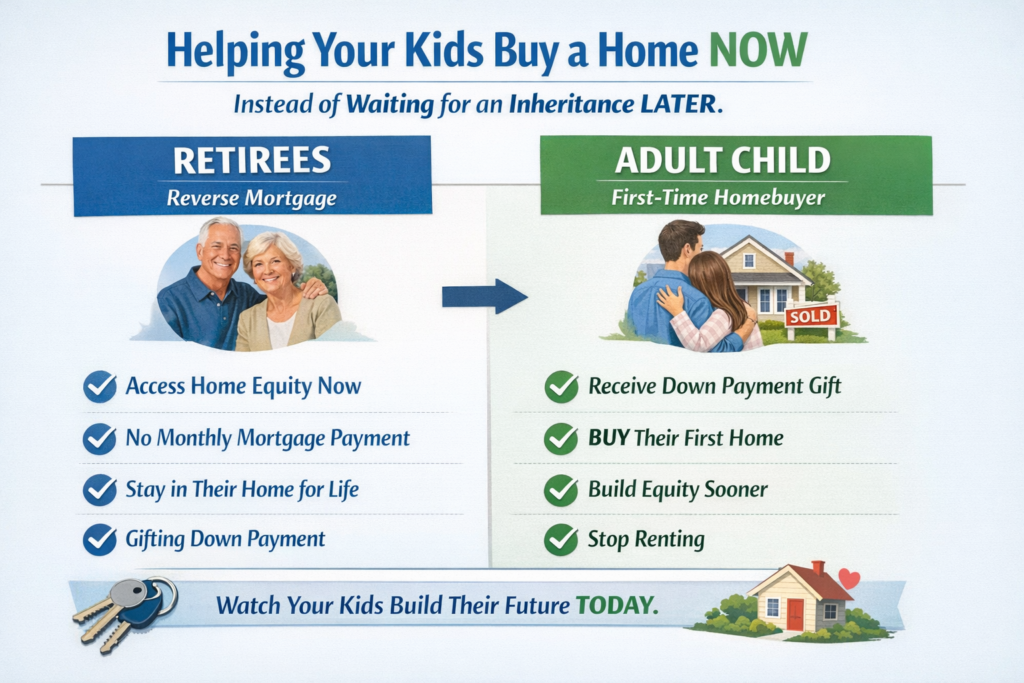
How a Reverse Mortgage Can Help Your Adult Children Buy a Home—Without Waiting for an Inheritance
For many retirees, their home is their largest asset. At the same time, many adult children are struggling to buy their first home due to rising prices, higher interest rates, and the challenge of saving for a down payment.
This creates an important question for families:
Why should children have to wait for an inheritance to benefit from home equity, when that equity could help them today?
 As a Certified Reverse Mortgage Specialist, I help families explore how a reverse mortgage can be used strategically—not just for retirement income, but also as a powerful family planning tool.
The Challenge Facing Today’s First-Time Homebuyers
Across Texas—and especially in markets like Dallas–Fort Worth—first-time buyers face several obstacles:
- Rising home prices
- Difficulty saving for a down payment while renting
- Student loan and consumer debt
- Competition from cash buyers and investors
Even financially responsible adult children often need help getting over the down-payment hurdle. Meanwhile, many parents are retired, mortgage-free, and sitting on significant home equity.
That’s where a reverse mortgage can change the conversation.
What Is a Reverse Mortgage (and What It Isn’t)
A reverse mortgage allows homeowners age 62 or older to access a portion of their home equity while continuing to live in the home.
Key points to understand:
- The homeowner keeps ownership of the home
- There is no required monthly mortgage payment
- The loan is repaid when the homeowner permanently leaves the home
- Funds can be received as a lump sum, line of credit, or monthly payments
Most importantly, reverse mortgage proceeds can be used however the homeowner chooses, including gifting money to family members.
Using a Reverse Mortgage to Help Your Child Buy a Home Now
Instead of waiting years for an inheritance, parents can use a portion of their home equity today to help their child become a homeowner.
Here’s how it typically works:
- Parents obtain a reverse mortgage on their primary residence
- They access a portion of their available equity
- Funds are gifted to their child as a down payment
- The child purchases a home using traditional financing
There is no loan repayment required from the child, and the parents continue living in their home as usual.
Benefits for Parents
For retirees, this strategy offers several meaningful advantages:
- Access home equity without taking on a monthly mortgage payment
- Stay in their home for life as long as loan obligations are met
- Maintain control over how and when equity is used
- Create a living legacy by helping family now
- Potentially reduce future financial stress on adult children
Many parents say the biggest benefit is emotional—not financial. They get to see the impact of their hard work during their lifetime.
Benefits for Adult Children
For first-time buyers, receiving help with a down payment can be life-changing:
- Buy a home years earlier than planned
- Reduce or eliminate private mortgage insurance
- Qualify more easily for favorable loan terms
- Stop renting and begin building equity
- Gain housing stability in a competitive market
In high-cost areas like DFW, a down payment gift can be the difference between waiting indefinitely and buying now.
What About the Inheritance?
This is one of the most common concerns families raise.
Using a reverse mortgage does not mean there will be no inheritance. It means:
- The inheritance may be structured differently
- The family benefits from the equity at a more impactful time
- Adult children may already own a home by the time the loan is repaid
Many families decide that helping children establish financial stability earlier in life is more valuable than leaving unused equity behind.
Is This Strategy Right for Every Family?
No—and that’s important to say.
A reverse mortgage used for family gifting works best when:
- Parents plan to remain in their home long-term
- There is sufficient equity available
- Parents are financially secure without relying on that equity for daily expenses
- The strategy is coordinated with the child’s mortgage lender
This should always be evaluated carefully, with clear communication among all parties.
Reverse Mortgage FAQs: Helping Your Adult Children Buy a Home Now
Many families are asking whether a reverse mortgage can be used to help adult children buy a home—especially as first-time buyers struggle with down payments and rising prices.
Below are answers to the most common questions I hear as a Certified Reverse Mortgage Specialist.
Can a Reverse Mortgage Be Used to Help My Child Buy a Home?
Yes. Reverse mortgage proceeds can be used for any purpose, including gifting money to your adult child to help with a down payment or closing costs.
There is no restriction on gifting funds to family members, as long as the reverse mortgage is set up correctly and the homeowner meets program requirements.
Do I Still Own My Home with a Reverse Mortgage?
Yes. You retain full ownership of your home.
A reverse mortgage is a loan, not a transfer of ownership. Your name stays on the title, and you continue to live in the home as long as you meet basic obligations such as paying property taxes, homeowners insurance, and maintaining the property.
Do I Have to Make Monthly Mortgage Payments?
No. One of the defining features of a reverse mortgage is that no monthly mortgage payment is required.
Interest accrues over time and is typically repaid when the home is sold, the homeowner permanently leaves the home, or passes away.
Can Reverse Mortgage Funds Be Gifted to My Child?
Yes. Reverse mortgage funds can be gifted to your child as a down payment gift.
From the child’s lender’s perspective, the funds are treated like any other acceptable gift, subject to standard gift documentation requirements.
Does My Child Have to Pay Back the Reverse Mortgage?
No. The reverse mortgage is the parents’ loan—not the child’s.
Your child has no repayment obligation, no lien on their home, and no financial responsibility for the reverse mortgage.
Will Using a Reverse Mortgage Eliminate My Children’s Inheritance?
Not necessarily.
Using a reverse mortgage may reduce the remaining equity in the home, but many families decide that helping children buy a home earlier in life provides more long-term benefit than leaving unused equity behind.
In some cases, adult children already own a home by the time the reverse mortgage is repaid—creating wealth sooner rather than later.
Can I Still Leave My Home to My Children?
Yes. When the reverse mortgage becomes due, heirs typically have options, including:
- Selling the home and keeping any remaining equity
- Refinancing the balance and keeping the home
- Paying off the loan through other means
Reverse mortgages are non-recourse loans, meaning the amount owed can never exceed the value of the home.
What Are the Requirements to Use a Reverse Mortgage This Way?
This strategy generally works best when:
- The homeowner is age 62 or older
- The home is a primary residence
- There is sufficient equity available
- The homeowner plans to stay in the home long-term
- The parents are financially stable without relying on that equity for daily living
Each situation should be reviewed individually.
Is This Strategy Right for Every Family?
No.
A reverse mortgage used to help children buy a home should always be evaluated carefully. It may not be appropriate if the homeowner needs the equity for future care, plans to move soon, or has limited remaining equity.
That’s why education—not pressure—is critical.
How Is This Different from Taking a HELOC or Cash-Out Refinance?
Unlike a HELOC or cash-out refinance, a reverse mortgage:
- Does not require monthly payments
- Does not rely on income qualification in the same way
- Allows retirees to preserve cash flow
For many retired homeowners, that difference is significant.
Final Thoughts
A reverse mortgage isn’t about giving up your home or risking your future. When structured correctly, it can be a thoughtful way to use the wealth you’ve built to support the people you care about—when it matters most.
If you’re a homeowner age 62 or older and wondering whether your home equity could help your children buy a home now, it’s worth having an informed conversation.
I’m Richard Woodward, Certified Reverse Mortgage Specialist, and I help families understand whether this type of strategy makes sense for their specific situation.


